Beyond Velocity: How to Prevent "AI Code Slop" From Ruining Your Codebase
AI assistants speed up implementation but bottleneck code review. Six silent failure modes, intent-driven engineering, and five guardrails to scale velocity without technical debt.
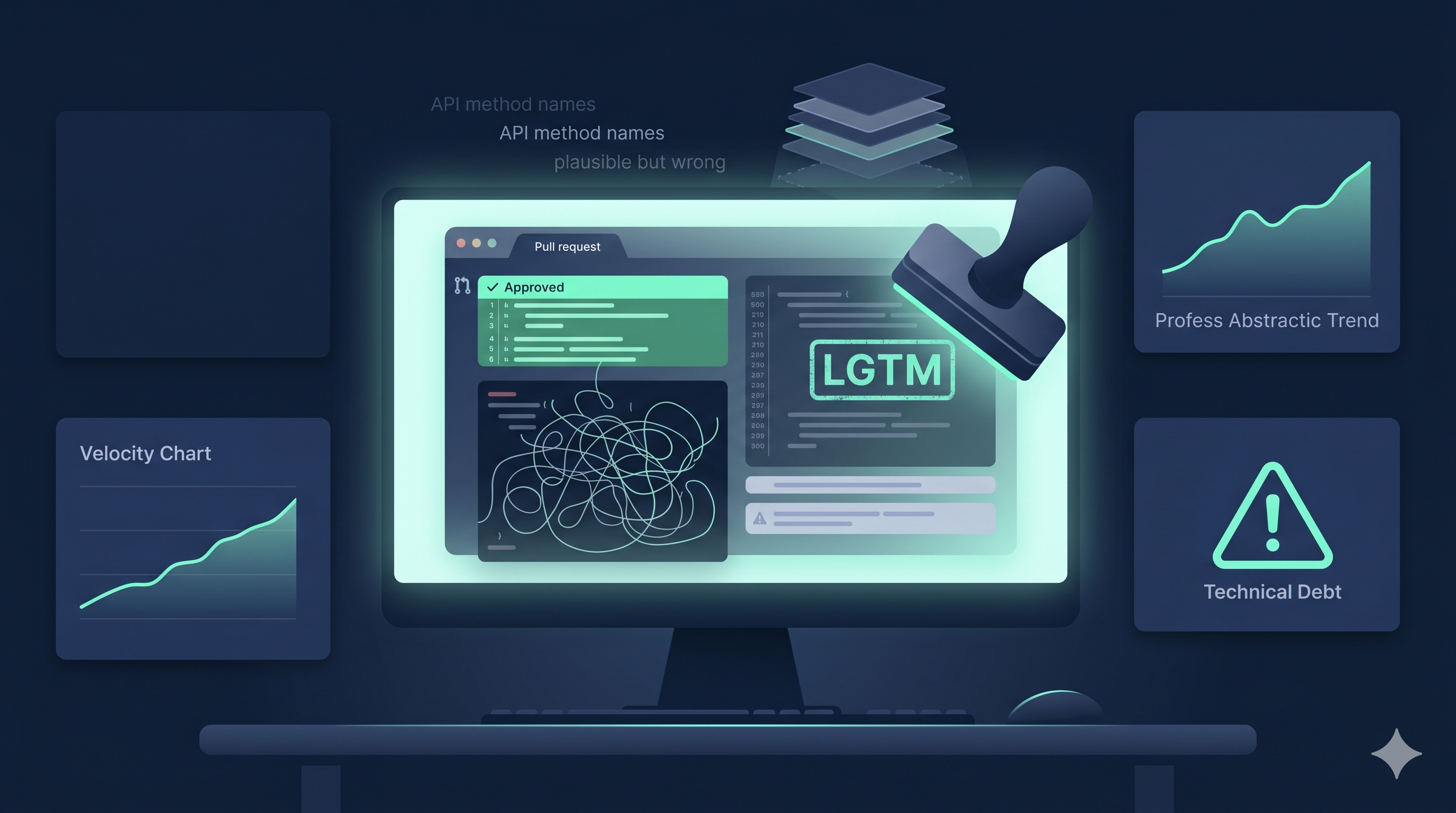
An In-Depth Guide to Optimizing AI-Generated Engineering Output and Mitigating Technical Debt
The software engineering landscape is experiencing an unprecedented shift. With advanced LLMs and AI coding assistants like Claude Code and GitHub Copilot, developers can generate functional code at ten times the speed of a human engineer. Executive dashboards show soaring pull request metrics, and velocity charts look cleaner than ever. However, a silent crisis is brewing beneath the surface of modern repositories: the exponential accumulation of "AI Code Slop."
While AI speeds up the actual implementation phase, the traditional engineering lifecycle is bottlenecked at the review stage. Human developers, buried under massive 500-line diffs, lack the bandwidth to audit every line meticulously. The result is a dangerous trade-off: either teams block structural velocity with exhausting human verification, or they rubber-stamp PRs and inject invisible technical debt directly into production.
The Anatomy of AI Code Slop: 6 Silent Failure Modes
AI code slop is uniquely dangerous because it effortlessly passes basic syntactic validation and structural "eye tests." It looks plausible, compiles perfectly, and easily satisfies superficial reviews, yet it remains fundamentally broken or misaligned. Here are the six primary ways AI-generated output compromises a codebase without looking wrong:
-
Plausible but Incorrect Logic
This represents the most critical risk category. The code features clean syntax and logical formatting, but the underlying execution paths or algorithms are fundamentally flawed. Catching these bugs demands deep context regarding systemic intent rather than static code evaluation.
-
Over-Engineering and Artificial Complexity
Trained on vast enterprise systems, LLMs tend to over-anticipate future generalization requirements. A feature that genuinely demands 15 straightforward lines of code can easily morph into a 200-line multi-layered abstraction framework that no one requested and nobody wants to maintain.
-
Convention Blindness
AI models excel at producing generic, syntactically standard code, but they remain natively blind to your repository's specific architecture unless strictly instructed. They routinely bypass internal standards for error handling, naming paradigms, logging structures, and internal module boundaries.
-
Hallucinated APIs and Deprecated Usage
An AI model will confidently invent non-existent library methods, invoke configuration fields deprecated multiple versions ago, or attempt to query internal endpoints inaccessible within the current execution microservice context. These errors often pass compilation and trigger failures only under niche production conditions.
-
Defensive Overreach and Silent Failures
To ensure code executes without crashing, AI systems frequently rely on aggressive, broad try-catch architectures. While this prevents unhandled exceptions, it often swallows critical errors silently, masking root defects and turning future maintenance into a debugging nightmare.
-
Cargo-Cult Engineering
AI excels at pattern replication but lacks functional reasoning. It will readily copy highly complex architectural mechanisms—such as synchronous circuit breakers or advanced retry logic—into scenarios where those patterns are completely unnecessary or actively harmful.
The Missing Core: Intent-Driven Engineering
Traditional workflows assume that human intent accompanies code across the entire lifecycle. When a human engineer develops a pull request, they bring implicit understanding regarding why tradeoffs were made, which alternatives were discarded, and what edge cases were prioritized. AI-generated code strips this human intent out completely, leaving an implementation artifact completely separated from its initial engineering reasoning.
Automated tests offer an incomplete safety net. They evaluate code exclusively within the bounds defined by the test author. AI-generated code introduces unique, unanticipated failure modes that exist outside the developer's original assumptions. Consequently, you cannot reliably write tests against requirements you did not explicitly know to articulate.
The Solution: Move the primary engineering gate upstream. Instead of reviewing code after it has been created, engineering teams must formalize, review, and lock down product intent before a single line of code is ever generated.
5 Practical Guardrails for Engineering Leaders
Adopting an intent-driven workflow doesn't require complex, over-processed methodologies. Teams can mitigate code slop immediately by establishing five clear architectural interventions:
-
Scope AI Subtasks Tightly
Broad, open-ended directives like "build this feature" yield the highest rates of AI slop. Force developers to decompose complex features into atomic, well-defined units (e.g., a single function, a tight API contract, or a localized refactor) with explicit verification checkpoints between them.
-
Elevate Intent to a First-Class Artifact
Establish a mandatory, lightweight template that explicitly documents the scope, explicit acceptance criteria, and intentional out-of-scope parameters for any AI-assisted task. Leverage AI models themselves to effortlessly synthesize these structured acceptance criteria directly from high-level briefs.
-
Shift Code Reviews to Spec Reviews
Catching systemic design flaws post-implementation is incredibly expensive. Front-load alignment by requiring engineering spec reviews before triggering code generation. Let the spec review solve conceptual problems, freeing post-generation review to focus entirely on codebase styling and convention adherence.
-
Enforce Layered Automation Filters
Never bypass foundational automated quality checks. While linting, static analysis, type checking, and test suites won't catch high-level logic flaws, they act as an essential first filter. Stacking these automated guards ensures human reviewers spend zero energy on surface-level code cleanups.
-
Build and Maintain a Team "Slop Register"
Every engineering codebase has architectural quirks that AI consistently misinterprets. Document these recurring hallucinations, anti-patterns, or deprecated invocations in a centralized team Slop Register. Use this document to directly optimize engineering prompts and feed specific validation rules into your CI pipeline.
Embracing the AI Transition Safely
Shifting to a spec-first, intent-driven architecture may initially feel like adding operational overhead to teams accustomed to immediate generation. However, this structure simply shifts engineering focus to where it matters most. By defining the "what" with extreme clarity before letting automation handle the "how," engineering organizations can safely scale development velocity without drowning in technical debt.